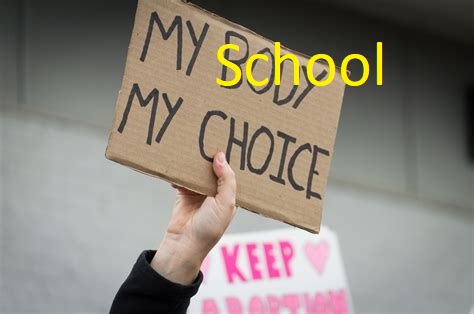
Why is it so hard to make education choice easy? Even many homeschoolers oppose some of the school choice initiatives being offered by our benevolent masters.
The problem stems from government trying to provide “free” education when such a thing is not possible, especially if the education is of the currently popular “indoctrination” style where kids attend a classroom and sit in an assigned seat and “learn” all together at the same pace with a fixed “one size fits all curriculum”. Students that don’t fit this mold become identified as “special” and are shoved into another “some sizes fits others” program tailored to their “needs”.
What government seems to want to do is to redistribute wealth in a way that provides for this public education for all rather than simply holding parents, the private sector, and charity responsible for that job.
When Thomas Jefferson created the first public school system for Virginia, he made it minimal and bible based but that just could not last because it was based on collectivist redistribution of wealth and some central control.
With wealth redistribution come strings and it’s impossible to get rid of them, if for the only reason to prevent misuse of the funds or fraud. After all “that’s not YOUR money”! (Actually it IS your money, you’ve just lost control of it. This is the sneaky thing that collectivism does that we generally don’t realize.)
Those who want collectivist schooling for their children must pay the bill themselves so that those that don’t want it can afford to pay for what they want. That is the only truly fair and free way to do it.
At first this seems insane to most who have seen nothing but collectivist systems of education all of their lives.
However, biting the bullet and taking full responsibility for your child’s education will throw you back into the days when our founding fathers were kids. Reading by candlelight from books obtained by whatever way was possible. That simple system produced some of the best educated individuals who founded this country based on a genius system of checks and balances. Our founders didn’t need truency laws to motivate them to learn.
Others were left behind, but even the poorest and most disadvantaged could get an education if they wanted it bad enough anytime they were ready.
Today we don’t need hard-copy books or candles to teach ourselves whatever we want to learn. With basic point and click reading skills, a child can educate themselves to any level desired on any subject desired.
All that is needed, in addition to access to a computer online, is a parent that will keep the students out of the dark-side of the internet and motivate them not to cheat with AI in a way that bypasses true learning, and to instill a moral standard that will produce a citizen capable of governing themselves in a way that promotes a healthy society.
The time for collectivist forms of education are coming to an end if we can just get the government out of the business of redistributing wealth to provide for “free” education.
See what Elon Musk says about learning and education.
A response from Audra:
At the outset, let’s be clear about the term “school choice.” Based on your comments and article I am confident you all know what is really meant by the phrase, but humor me for the sake of clarity: school choice isn’t about the ability to choose an educational method or location (which we have broad liberty to do in Idaho), but about the government funding of that choice. And when we say “government funding” it means taxpayer funding.
I also want to take just a minute and narrow the focus of what is going on right now in the legislature. We all know public education is flawed and it isn’t a stretch to say that the problems we see today are simply the fruit of a system doing what it was designed to do. We could spend a lot of time on whether the answer is to “fix” the system or to dismantle it, but I don’t want to get bogged down in that conversation because it actually doesn’t affect the inherent problems of school choice legislation.
The move to publicly fund private and homeschools is not new in Idaho, but in the last 5 years it has become the focus of the republican party and powerful outside lobbying interests. When SB 1038 came roaring through in 2023, it was clear from the language of the bill and the rhetoric of the sponsors that the goal of providing public funding for non-public options wasn’t really about funding poor kids trapped in failing public schools, but it was about literally bankrupting public schools. It failed in spite of a lot of support from organizations in and out of the state. I won’t dive too deep into how big an impact those outside interests have had on this issue in Idaho.
Since then, school choice proponents have softened their language and pushed legislation as the answer for students for whom public schools are not a good fit.
HB 93 is a refundable tax credit that offers up to $5,000/child for families who make up to 300% of the national poverty rate. This bill primarily focuses on costs associated with private schools, tutoring, and pod or micro schools (it is worth noting that there is no statutory definition of a pod or micro school). The language of the bill seems to prohibit homeschool parents from “paying” themselves to homeschool, however it does not seem to prevent parents from claiming expenses associated with tutoring or participation in pod or micro schools or educational materials. A refundable tax credit allows families to receive more on their tax return than what they paid in taxes. It requires recipients/private schools to keep receipts and/or a portfolio of learning in the case of an audit. This government subsidy would be administered through the tax commission and the penalties for misuse of the tax credit would be felony tax fraud.
The concerns within the bill itself are many and I will try to keep them to the most obvious:
- by applying for a tax credit, participants are in fact creating a registry of children who are being educated outside the public school system. Idaho currently does not track children who are in private or homeschools.
- participants in fact are receiving more than they pay toward public schools and, in fact, may receive more than their entire tax liability.
- because participants are likely to receive more than they paid in taxes, they are receiving the benefit of other people’s tax money, including those who are not eligible for this particular tax credit.
- because this bill sets eligibility at 300% of the national poverty rate, nearly all Idahohans meet the income requirements – it does not actually target poorer families, though it may prioritize them.
- this bill relies on the tax commission to implement; it is unclear if the tax commission has the staffing available to properly manage this program.
- the tax commission is not equipped to audit in a meaningful way whether the tax credit was used properly.
- the bill indicates that schools receiving the tax credit must be accredited, but does not define what accredited means.
- the parent is the accountable party when it comes to who the state will look to in order to insure the monies are properly spent.
- the loudest supporters of this bill are private schools and private school families; public funding is a financial boon to private schools.
- fuel costs to drive a child to and from a private school are considered an eligible expense.
There are also the broader concerns associated with school choice legislation in general:
- taking money from one group of taxpayers to pay for the private choices/privileges of another group of taxpayers is redistributionist.
- any time public dollars are handed to private parties (whether it be business or individuals) the taxpayer is owed an accounting of that spending (otherwise we end up with things like cronyism, to start).
- accountability leads to regulation.
- school choice programs are rampant with fraud.
- school choice programs always increase the cost and scope of the government.
- school choice programs always consolidate benefits in wealthy, urban areas where there are an abundance of private and parochial schools to choose from.
- school choice programs actually harm rural schools – it takes losing fewer students in a small school to result in a catastrophic collapse of the local schools or, requires increased levying to keep them open, thus placing larger financial burdens on poorer areas.
- 80-95% of those who receive school choice money were already attending private schools; this amounts to a subsidy for wealthy families.
- school choice programs actually cause inflation in the education market, leading to private school tuition increases and increased costs of educational materials and extra curriculars (the Empowering Parents Grant program has already caused inflation as private businesses try to capture those extra public dollars for the services they were already providing).
- school choice programs have been shown to increase the cost of all education.
- all school choice programs turn those education choices into government funded education – if the government funds it, the government controls it. Please see UNESCO’s goal to have all forms of education funded by the government.
A relevant example:
Oklahoma, a deeply red state, passed a “no-strings-attached” refundable tax credit bill 3 years ago. Idaho’s HB 93 was originally modeled after their program. Since then Oklahoma has seen:
- tax credits being used to pay off student loan debt and other tax liability before being used for education expenses; educational expenses have included many questionable items.
- the cost to implement the program increased from $1 million to $4 million – they have had to appropriate that additional funding from other places in the general budget because it wasn’t accounted for in the original appropriation metric.
- efforts underway to allow the tax commission to work with the department of education to require state testing of those receiving the tax credit – read that as new strings attached.
- the tax credit refund checks are made out to parents, but are sent directly to private schools for tuition costs – this is meant to streamline the process, but legislators were told that the tax credit was not a voucher (payment directly to a private school)
- riding on the wave of efforts to add requirements to those receiving funding, there are efforts underway to add regulation to homeschoolers not taking funding.
- Oklahoma had to recently modify the program because these tax credits were being used to pay for private schools outside the state.
- accreditation is not clearly defined, so a private school that received money was accredited through the Association of Zoos and Aquariums (this is just an example of this particular issue).
This is just the tip of the iceberg of the problems that always exist in public/private partnerships and education is no different.
HB 93 stands to pass the Senate by one, maybe two votes, likely on Monday.
While many legislators see the risk of school choice legislation, it doesn’t always seem to be enough to dissuade them from voting in favor of HB 93. The reality is that voting against school choice legislation is politically risky, especially since it seems to be the sacred cow of the last few legislative cycles and detractors are viciously attacked in the media. It is my hope that you would perhaps be willing to reach out to your Senator to encourage them to stand against programs like this that redistribute wealth in the name of educational choice; that their constituents will have their back.
If we don’t like how the government manages our current system, why would we give them permission to try again with our private and homeschools? And why should we be asking taxpayers to pay for two systems of publicly funded education? School choice legislation should matter to everyone because it is all our tax dollars that will pay for it.
HB 93 will be heard next week on the Senate floor, likely Monday. So, time is of the essence.
Sincerely,
Audra

 Patrons of 244 for Transparency
Leave a comment